Why study ‘Mountain Watershed’?
Many cities are situated in lowland areas and are located far from mountains. Thus, one may ask: why study ‘Mountain Watershed’? Indeed, studying mountain watersheds is tough. Typically, they are difficult to reach in the first place, moving up and down slopes is tiring, and greater attention is required to ensure safe work practices. Nonetheless, we set foot in the mountains because we believe that the diverse and dynamic processes occurring there (Fig. 1) – which we often overlook – could eventually harm our safety and the surrounding environment. For example, mountain forests can be disturbed by logging, fire, storms, and earthquakes. If forest cover is lost, rainfall that would otherwise be intercepted by the canopy or infiltrated into permeable soil may instead emerge at the surface and travel downslope. A greater amount of water flowing over the surface would erode more soil and transport sediment further downslope and downstream. Eventually, both water and sediment would arrive at the downstream site (where we live) in greater concentrations at shorter timescales, potentially causing adverse effects on flood management and aquatic ecosystems. Yet, it is easier said than observed. We know surprisingly little about how a given watershed would react to a given disturbance, primarily because observations in harsh mountain environments are challenging. Diverse and dynamic processes within watersheds (Fig. 1) also blur the cause-and-effect relationships. We are grateful for the advancements in remote sensing and environmental modeling, but they still cannot replace ground-truth field data because phenomena are often not visible in images, and reality is more complex than models. Therefore, while incorporating cutting-edge digital technologies, we head to the mountains to observe critical yet overlooked processes that may one day affect our society downstream.
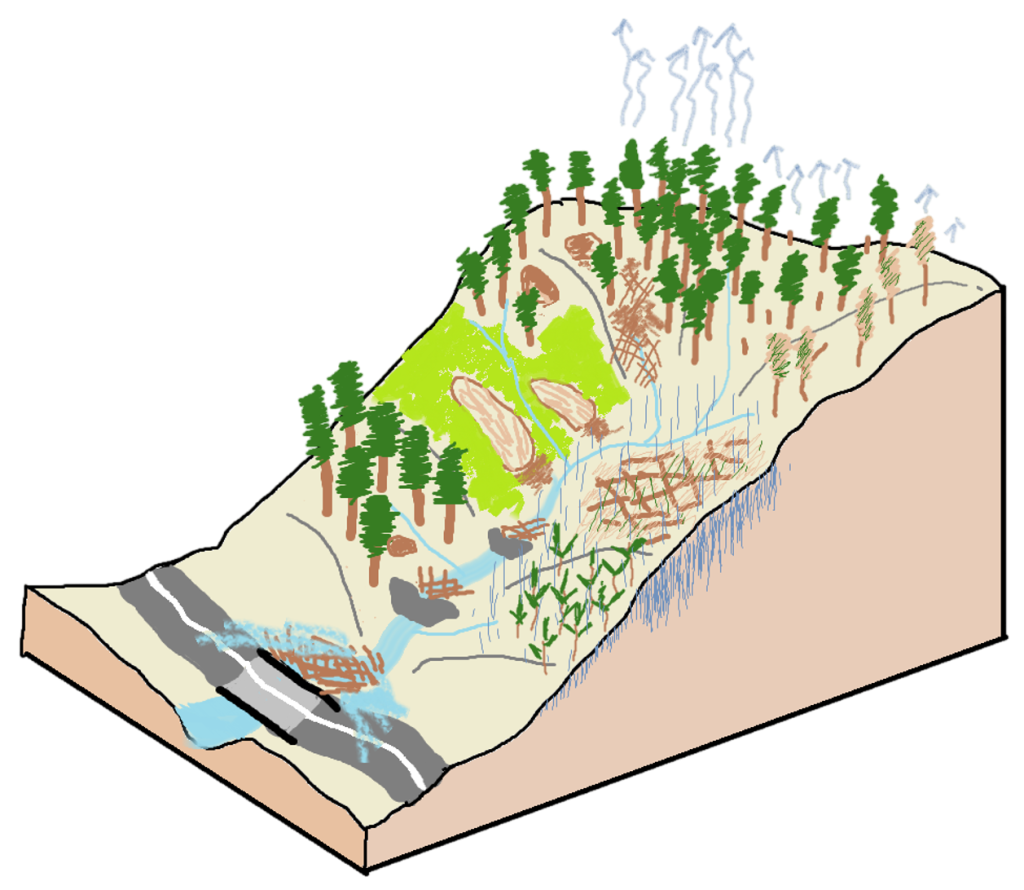
図1 山地流域で繰り広げられる多様かつダイナミックな現象
山地流域管理学の魅力
山地流域管理学研究室では、フィールドでの観測やリモートセンシング、モデリングなど様々な技術を組み合わせることで植物-水-土砂の相互作用に対する理解を深め、より良い山地流域管理の在り方を探求します。私たちの考える山地流域管理学の魅力は
1. 社会に貢献できること
2. 新しい技術に挑戦できること
3. 自由な研究が行えること
の3点に集約されます。第一に、私たちは山地流域の中で起こる様々な現象(図1)を研究対象にしていますが、この中には例えば洪水や渇水、土砂災害や水質汚濁など、地域社会や国際社会の課題となっているものが少なくなく、専門知識や研究成果を社会課題の解決に役立てられることが大きな魅力となっています。同時に、山地流域(社会)を取り巻く環境は目まぐるしく変化しており、時には未曾有な大規模災害に見舞われることもあれば、近年ではAIに代表されるデジタル技術も急速に発展しています。山地流域管理学では広大な研究対象に比べて研究に取り組む人が少なく、資源の有効活用による新たな課題の解決が求められるため、常にリスキリングを行える環境にあることも魅力です。最後に、上流で起こる「撹乱」には農業や林業のように数年~数百年続くものがあれば、大雨や火山噴火、地震のように数秒~数時間で大きなインパクトをもたらすものもあります。また、これら「撹乱」の影響には衛星画像からも判別できるマクロなものがあれば、分子レベルの分析から初めて明らかになるミクロなものもあります。このように、山地流域管理学では時間スケールや空間スケールを自由に行き来しながらテーマを設定し、他分野の知見や技術も積極的に取り込みながら探究を行えるのが魅力となっています。